SPCX: Trading Price Discovery on Pre-IPOs
We expected the Nasdaq opening auction to pull the SPCX perpetual toward a new pricing consensus. The direction was right. The timing—and the amount of information left to discover—was not.
/01Research Question
Pre-IPO perpetuals let traders take exposure to a company before its shares list. On an IPO’s first trading day, the listing exchange conducts an opening price-discovery process using incoming orders: the period between the market open (09:30 EDT) and the start of public trading in the new shares, usually three to four hours later. During this window market participants place bids for the common stock, and the exchange publishes an indicative clearing price — the near price — computed from order book imbalance. The pre-IPO perpetual keeps trading throughout, with traders and oracles continually adjusting their estimate of the eventual opening print.
The question was whether that auction introduced information the perpetual market had not yet absorbed. If it did, the gap between the derivative and the auction-implied value should narrow as the opening book developed, with the final opening cross establishing a common reference for both markets.
On trade.xyz the perpetual’s oracle starts from an internal reference valuation and then follows order flow — an exponentially weighted moving average over the book’s own pricing, with funding pressing the traded price toward the oracle. At conversion the oracle switches to tracking the listed spot directly, which is why the venue has every incentive to walk it onto the true opening price beforehand.
/02Expectations Before the IPO
We had two previous pre-IPO conversions to study: Cerebras (CBRS) and Quantinuum (QNT). In both, the perpetual’s mark price and the auction’s clearing price started far apart and converged through the discovery period — a repeatable structure, and the basis of our expectation.
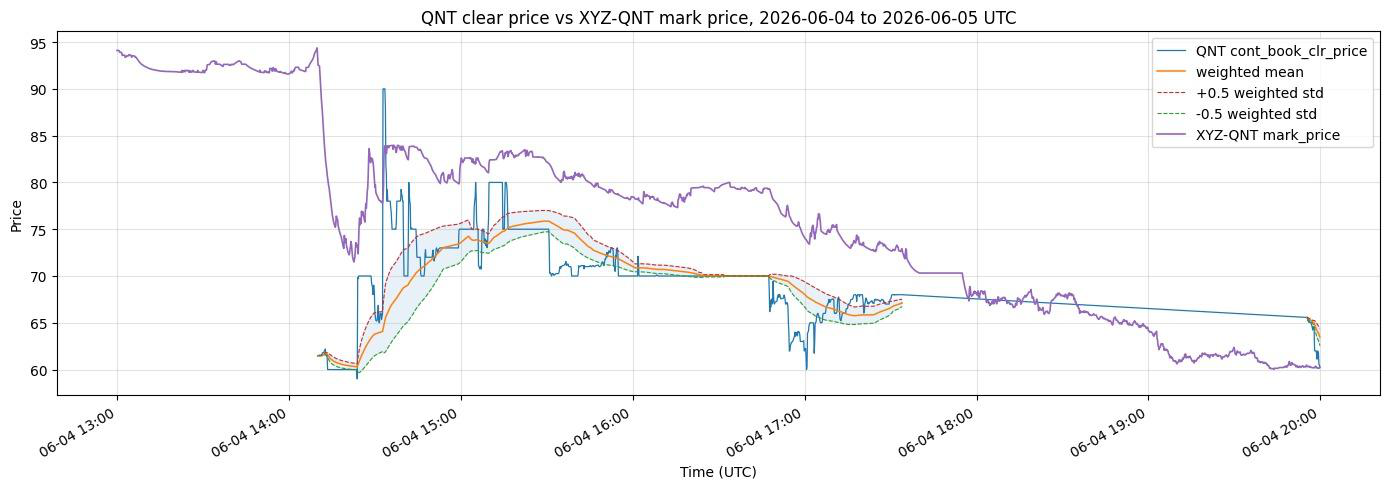
The expectation for SPCX was therefore straightforward: as Nasdaq’s order book accumulated demand, its indicative price would become an increasingly useful reference for the perpetual. We expected the two markets to converge through the discovery window, with the derivative tracking changes in the auction consensus and the remaining gap compressing once the opening price became firm.
We monitored Nasdaq DeepBook L2 data through IBKR alongside Databento’s auction reference data and Hyperliquid’s xyz-SPCX market. The purpose was to compare the pricing process across venues: how quickly information crossed between them, whether the relationship survived real execution conditions, and how SPCX differed from the two earlier conversions.
/03What Actually Happened
We were right that the prices converge. We were wrong about how fast. The SPCX near price converged to the Hyperliquid mid price in 22 seconds.
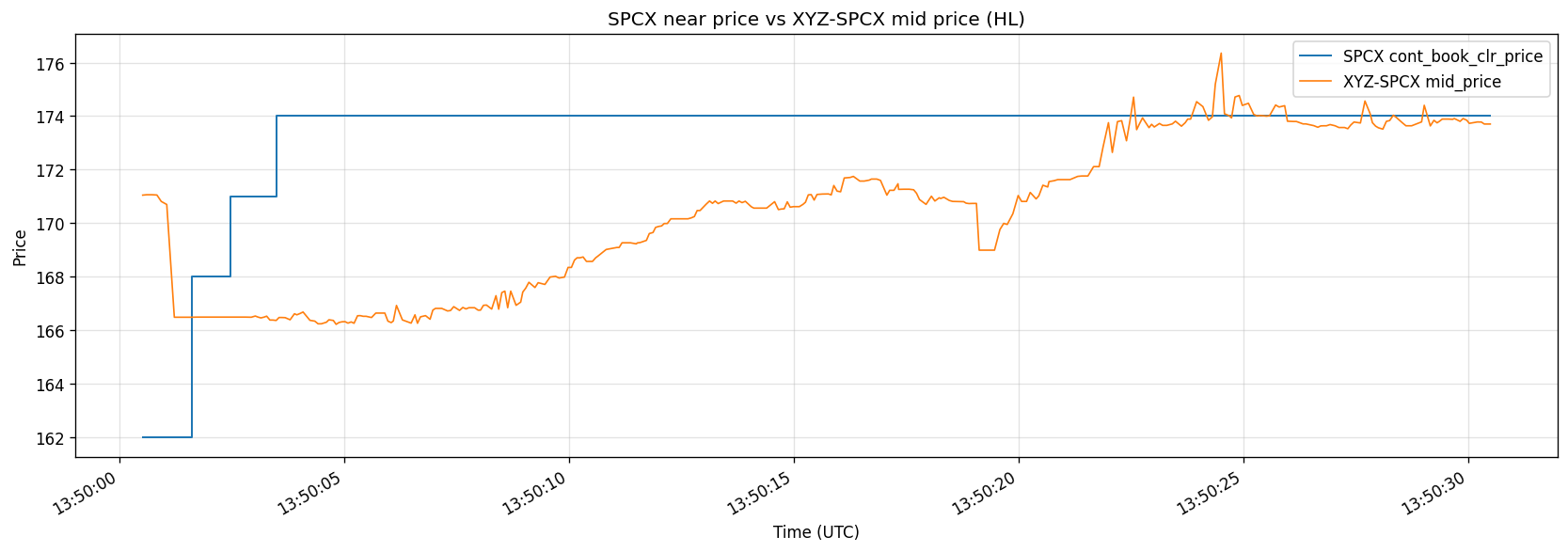
The culprit was volume. SPCX was by far the most traded pre-IPO perpetual to date — by the time the auction opened, price discovery on trade.xyz had already absorbed most of the information the auction might otherwise have revealed.
| demand (trade.xyz) | CBRS | QNT | SPCX |
|---|---|---|---|
| pre-listing volume | $47.9M | $18.4M | $794.3M |
| daily average (window) | $3.69M (13d) | $2.62M (7d) | $30.6M (26d) |
| conversion-day volume | $281.4M | $54.6M | $185.6M (first 30 min) |
| conversion-day ÷ pre-listing | 5.87× | 2.97× | pending (partial day) |
A second operational surprise: the near price did not begin broadcasting until 13:50 UTC (09:50 EDT) — a full 20 minutes after the US equities market opened. Any model that assumed a live auction feed from the opening bell simply had nothing to read for the first 20 minutes.
/04The Discovery Window
Across the core discovery window (13:30–15:50 UTC) the derivative mark and the TradFi auction consensus were strongly co-integrated — the perp tracked the staircase of the Nasdaq reference price closely.
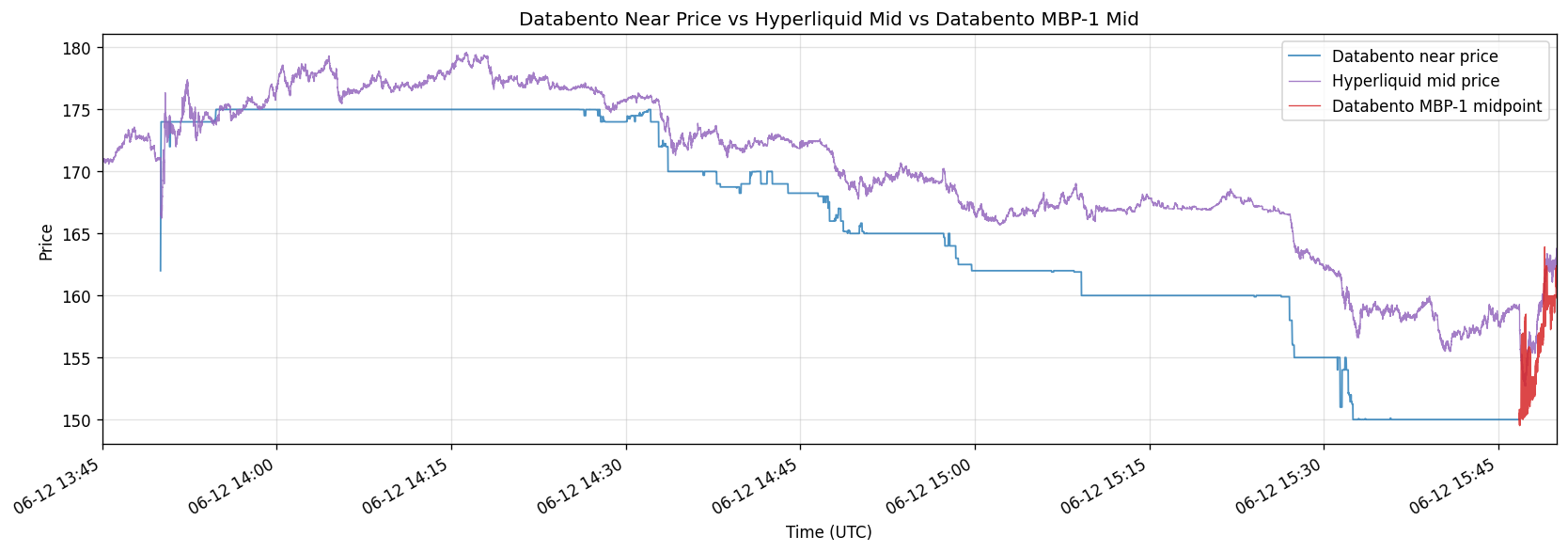
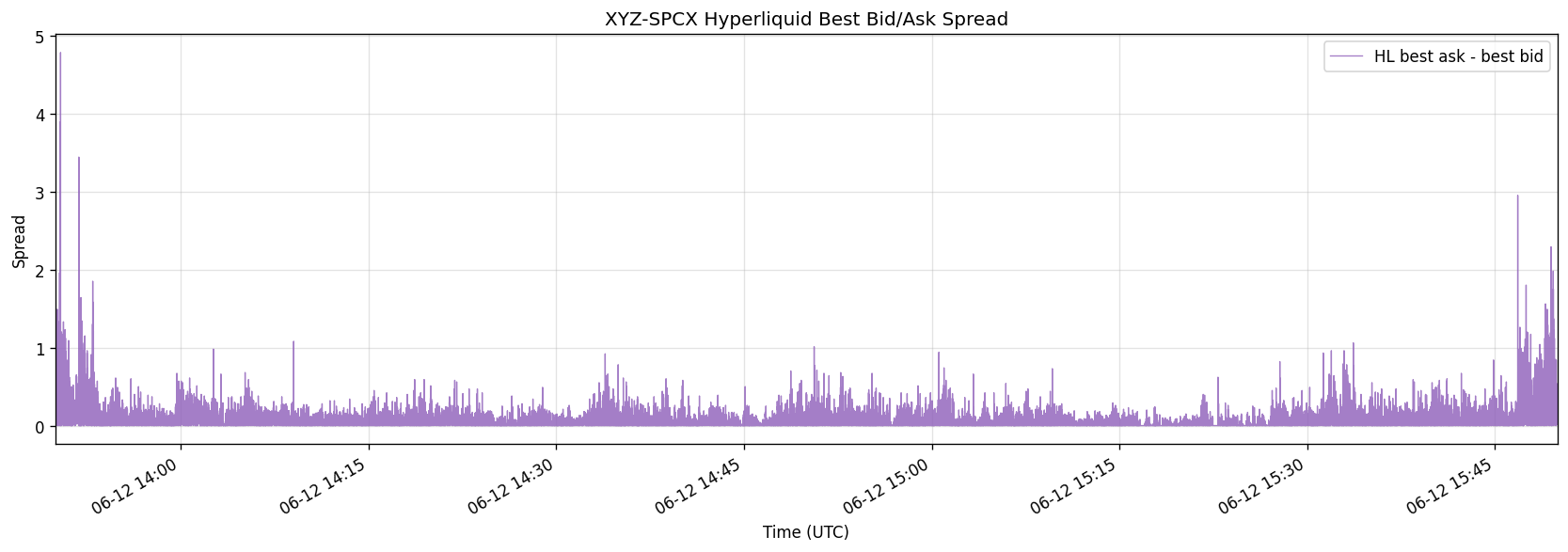
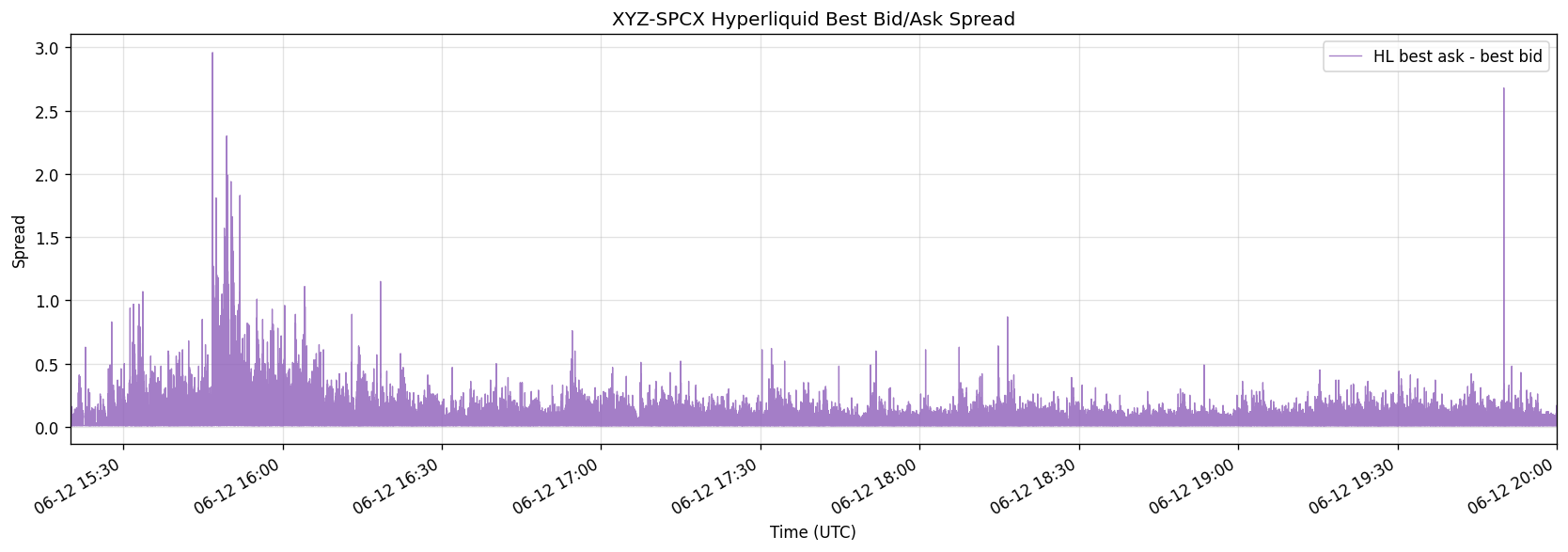
Execution conditions, however, were hostile. During price discovery the absolute bid-ask spread on the perp spiked repeatedly into a 1–5 USDC range — a 1–2% execution premium. Taker orders routed in this window suffered immediate capital degradation from toxic flow.
/05The Open
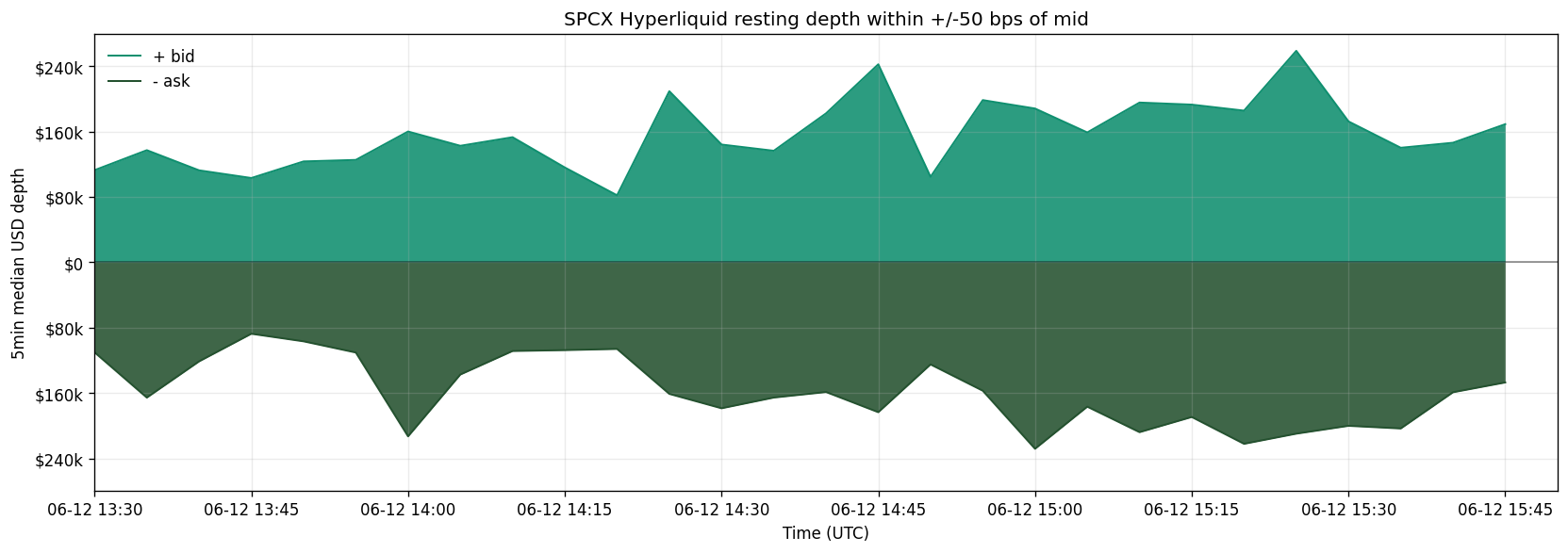
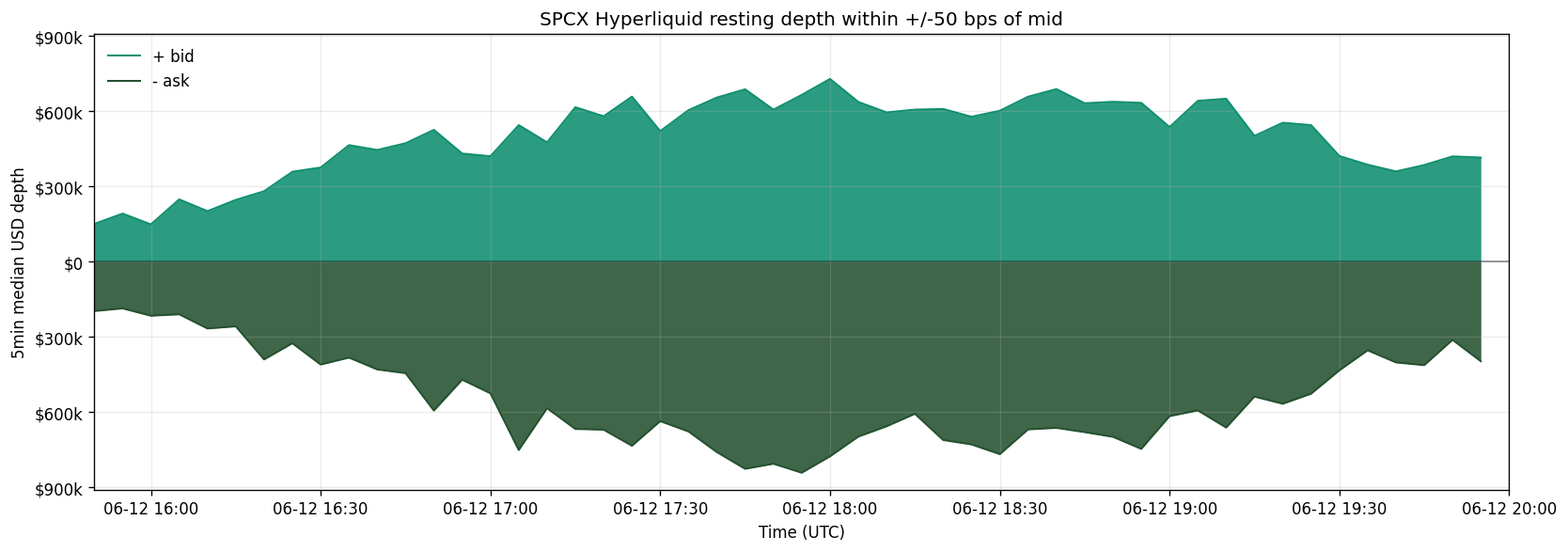
The moment the opening cross happened, institutional liquidity flooded the queues. The absolute spread compressed to a ceiling of 3 USDC — tighter than the discovery-period spikes — and resting depth within ±50 bps of mid grew from roughly $160k to $600–900k a side. This is the core hypothesis validated: aggressive basis mean-reversion once a pricing consensus exists on the primary engine.
/06What the Data Said
The directional expectation held: the derivative and the primary-market reference converged, and the opening cross produced a clear change in liquidity. What failed was the assumption that SPCX still contained a large amount of undiscovered information by IPO morning. Its perpetual market had already done most of that work.
The comparison with CBRS and QNT suggests that pre-listing volume is central to the structure. When the perpetual is thin, the auction can reveal genuinely new information. When the perpetual has already traded hundreds of millions of dollars, the auction is more likely to confirm an existing consensus than create one.
The Cerebras event makes the same point from the other side: Arrakis Finance’s study of the CBRS pre-IPO perpetual measured an 89-minute convergence to the official pricing on roughly $71M of pre-listing volume. SPCX, with $794M behind it, needed 22 seconds. Across these events, greater pre-listing participation coincided with a faster and smaller final adjustment.
Three conversions are not enough to establish a law, and volume is not the only difference between the events. Issuer profile, venue participation, market-maker coverage, and the quality and timing of the auction feed all matter. But the data changes the prior: auction-driven convergence appears most informative when the derivative market has had the least opportunity to form its own consensus.
The useful result is therefore not simply that two prices met. It is that the amount left for the IPO auction to discover depended on how much discovery had already taken place elsewhere.